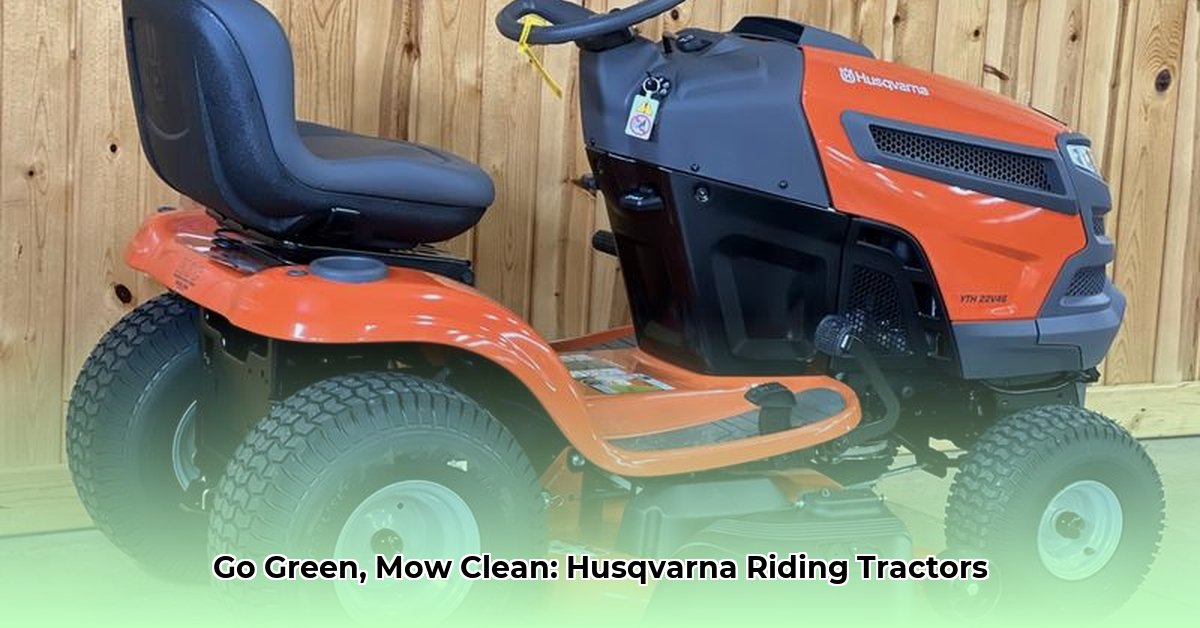
Choosing the right riding mower is crucial for both a beautiful lawn and a healthy planet. This guide helps you select the perfect Husqvarna riding tractor for your needs, comparing models and highlighting eco-friendly features. We'll explore long-term costs, maintenance, and sustainable lawn care practices. For more riding mower options, check out other mower options.
Understanding Husqvarna's Sustainable Approach
Husqvarna offers a range of riding tractors designed to balance power with environmental responsibility. Many models incorporate mulching capabilities, transforming grass clippings into natural fertilizer, reducing the need for chemical fertilizers. This "grasscycling" minimizes environmental impact and improves soil health. Furthermore, many Husqvarna tractors feature hydrostatic transmissions, known for their smooth operation and often superior fuel efficiency compared to traditional manual transmissions. This translates to lower fuel costs and a smaller carbon footprint.
But sustainable lawn care extends beyond the mower itself. Consider the total cost of ownership: fuel consumption, maintenance requirements, and the mower's lifespan. A fuel-efficient model with minimal maintenance needs represents a long-term investment in both your wallet and the environment. Isn't a lower environmental impact, coupled with lower long-term costs, a win-win situation?
Choosing Your Perfect Husqvarna: A Step-by-Step Guide
Selecting the ideal Husqvarna riding tractor requires careful consideration of several key factors. This step-by-step guide simplifies the process:
Step 1: Assess Your Lawn. Measure your lawn's size and complexity. A large, open lawn benefits from a wide cutting deck for maximum efficiency. However, smaller yards with obstacles require a more maneuverable machine.
Step 2: Budget Wisely. Set a realistic budget encompassing the initial purchase price, along with projected fuel, maintenance, and potential repair costs over the lifespan of the machine. Consider the total cost of ownership.
Step 3: Define Your Landscaping Style. Decide whether you prefer mulching (the most environmentally friendly option), bagging, or side-discharging grass clippings. Your choice will influence model selection.
Step 4: Prioritize Ease of Use. Consider the features that enhance user experience. Hydrostatic transmissions are often easier to operate and provide smoother control. Select a model that aligns with your comfort and physical capabilities.
Step 5: Research and Compare. Once you’ve narrowed your options, thoroughly compare specific models. Analyze fuel efficiency, maintenance schedules, and estimated lifespans. Read customer reviews and consult independent ratings.
Long-Term Cost Analysis: Sustainable Savings
The initial cost of a riding mower is just the beginning. Let's explore how to calculate long-term cost savings of sustainable riding mowers.
Total Cost of Ownership
Calculating the total cost of ownership is crucial. This involves adding the purchase price to the projected costs of fuel, maintenance, and repairs over the mower's lifespan. A fuel-efficient Husqvarna with minimal maintenance needs will likely result in significant savings compared to less efficient models. Doesn't minimizing operational costs appeal to both your budget and environmental consciousness?
Factoring in Fuel Efficiency
Fuel costs represent a significant portion of the total cost of ownership. The difference in fuel consumption between models can be substantial over several years. Prioritize fuel-efficient models to substantially reduce operating expenses and your environmental impact. How much could you potentially save on fuel over five years with a highly efficient model?
Maintenance and Repair Costs
Regular maintenance is essential for prolonging the life of your riding tractor. However, the frequency and cost of maintenance can vary between models. Consider models with simpler designs and fewer moving parts to minimize maintenance and the potential for costly repairs. Aren't fewer repairs and reduced downtime beneficial?
Example Calculation
Let's consider a hypothetical comparison:
- Conventional Mower: $2500 initial cost, $600 annual fuel, $250 annual maintenance.
- Sustainable Mower: $3500 initial cost, $150 annual fuel, $100 annual maintenance.
Over five years:
- Conventional Mower: $2500 + ($600 + $250) * 5 = $6250
- Sustainable Mower: $3500 + ($150 + $100) * 5 = $4750
This example demonstrates potential savings of $1500 over five years with the sustainable option. Actual savings will vary depending on usage and specific models.
Frequently Asked Questions (FAQs)
Q: How fuel-efficient are Husqvarna riding tractors? A: Fuel efficiency varies considerably across models. Check the manufacturer's specifications for precise fuel consumption data.
Q: What maintenance is required for a Husqvarna riding tractor? A: Consult your owner's manual for a detailed maintenance schedule, including oil changes, blade sharpening, and air filter replacements.
Q: Are all Husqvarna riding tractors environmentally friendly? A: Many models incorporate sustainable features like mulching and fuel efficiency improvements. However, environmental impact varies depending on the specific model. Consider fuel consumption, emissions, and overall lifespan when assessing environmental friendliness.
Choosing a Husqvarna riding tractor is about making informed decisions that benefit both your lawn and the environment. By considering these factors and performing your own cost analysis, you can select the perfect machine for your needs.